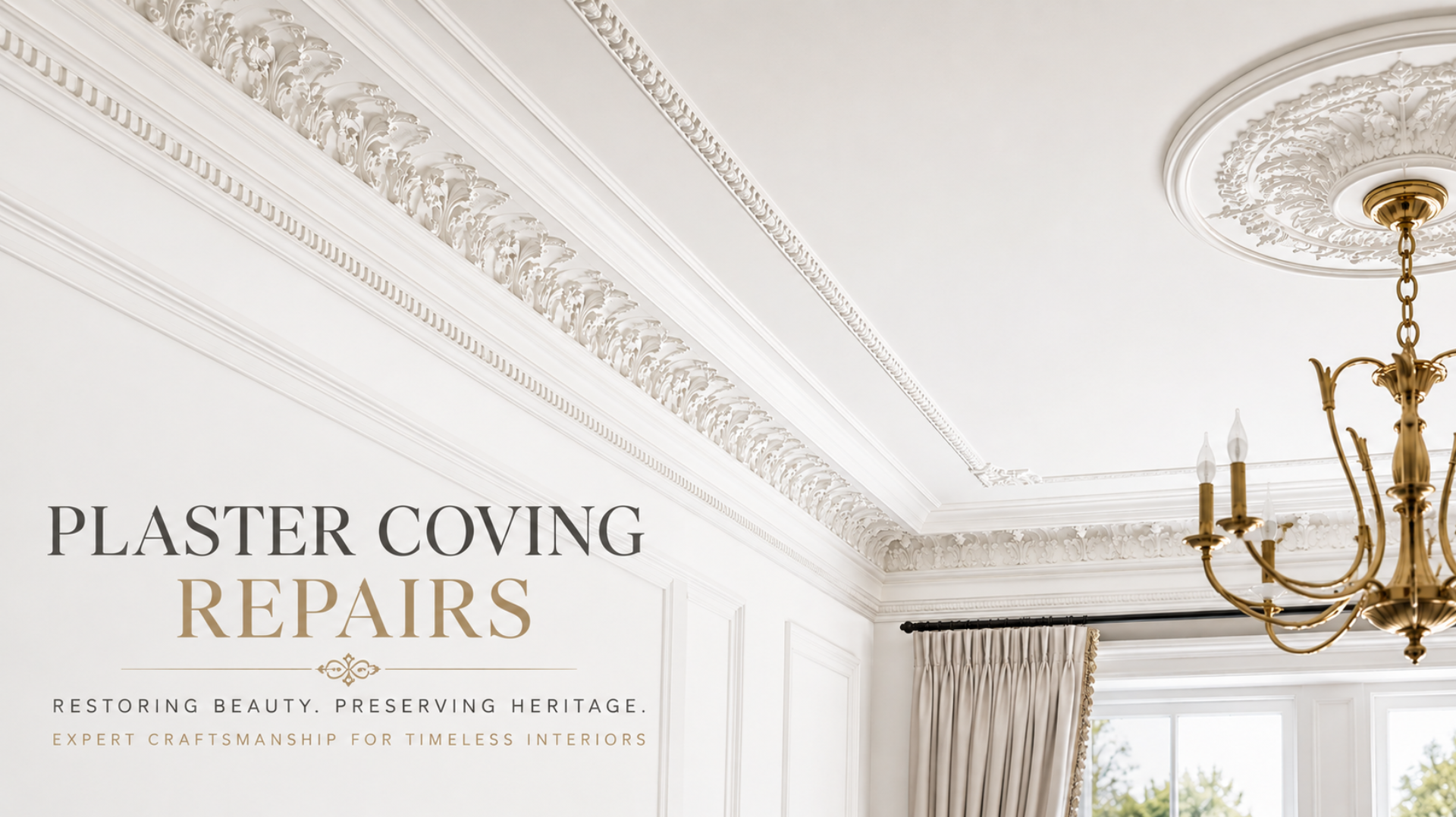
Plaster Coving Repairs Kent
Plaster coving is an important architectural feature that can add character, proportion and elegance to a property. From traditional Victorian and Edwardian homes to period cottages, Georgian properties and contemporary interiors, well-maintained coving creates a clean and attractive transition between walls and ceilings.
Plaster Coving Repairs provides professional plaster coving repair services throughout Kent. We specialise in restoring damaged, cracked, chipped and deteriorated plaster coving, with careful attention to the original profile and character of each property.
Whether you have a small section of damaged coving or require extensive restoration following building work, our approach is designed to produce a seamless and durable finish.
Professional Plaster Coving Repairs in Kent
Damaged coving can have a significant effect on the appearance of an entire room. Cracks, impact damage, water staining, loose sections and poorly repaired joints can make otherwise attractive interiors look unfinished.
Our plaster coving repair service is suitable for homeowners, landlords, property managers, builders and commercial property owners across Kent.
Where possible, we repair and retain the existing plasterwork rather than replacing an entire length unnecessarily. This helps preserve original decorative features while keeping the repair visually consistent with the surrounding coving.
What Causes Plaster Coving to Become Damaged?
Plaster coving can deteriorate for a variety of reasons. Some damage develops gradually through age and natural movement, while other problems can occur suddenly.
Common causes include:
- Settlement and minor movement within a property
- Cracks developing at joints
- Impact from furniture or building work
- Water leaks and previous damp problems
- Loose or failing sections
- Poor-quality previous repairs
- Removal of wallpaper or paint
- Ceiling repairs
- Electrical or plumbing work
- General ageing of plasterwork
Identifying the underlying cause is important before carrying out a permanent repair. Simply filling a visible crack without addressing movement or instability can result in the problem returning.
Coving Crack Repairs
Cracked coving is one of the most common problems found in older properties. Fine cracks may be relatively straightforward to repair, while larger cracks can indicate movement or separation between sections.
We carefully prepare damaged areas before repairing and blending the plasterwork. The objective is not simply to cover the crack, but to create a strong repair that integrates naturally with the existing coving.
Where joints have opened, additional preparation may be required to ensure the repaired section remains stable.
Repairing Damaged and Missing Coving
Coving can become chipped or broken when furniture is moved, ceilings are repaired or electrical work is carried out. In some cases, sections may be completely missing.
Rather than accepting an obvious patch, replacement sections can be shaped and finished to match the existing decorative profile as closely as possible.
For older or unusual properties, matching the profile is particularly important. A replacement piece that is the wrong size or design can stand out even after painting.
Water-Damaged Plaster Coving
Water leaks can cause plaster coving to stain, soften, crack or become detached from the ceiling or wall. Before repairing water-damaged coving, the source of the moisture should be identified and resolved.
Once the affected area is dry and stable, damaged plaster can be repaired or replaced as appropriate.
This approach helps prevent decorative plasterwork from being repaired only for the same problem to reappear.
Period Property Coving Restoration
Kent contains a wide variety of historic and period properties, and many retain original decorative plaster features. From Victorian terraces and Edwardian houses to Georgian properties and older cottages, original coving can form an important part of the character of a room.
We take a sympathetic approach to period plasterwork. Rather than unnecessarily removing original features, our aim is to retain as much sound material as possible while restoring damaged areas.
Kent includes numerous historic settlements and major towns, including Canterbury, Maidstone, Rochester, Dover, Faversham, Folkestone, Tunbridge Wells and Sevenoaks.
Matching Existing Plaster Coving
One of the most important aspects of coving restoration is achieving a good match with the existing profile.
Coving can vary considerably in:
- Width
- Projection
- Pattern
- Curvature
- Decorative detail
- Edge profile
- Surface texture
For this reason, replacing damaged coving with a generic modern profile does not always produce the best result.
Our repair-first approach allows the existing design to remain the main reference point. Where a section needs to be reproduced, careful measurements and profile matching can help create a more consistent finish.
Plaster Coving Repairs After Building Work
Renovation work can sometimes damage decorative plasterwork. Electrical installations, rewiring, plumbing, ceiling repairs, plasterboarding and other building work may require sections of coving to be removed or disturbed.
Once the main building work has been completed, damaged areas can be restored so the decorative finish looks complete again.
We can work with homeowners, contractors and other trades where plaster coving repairs form part of a larger renovation project.
Our Plaster Coving Repair Process
Every repair begins with an assessment of the affected area.
The process may include:
- Inspecting the existing coving and identifying the damage.
- Checking whether sections are loose or unstable.
- Assessing cracks, joints, chips and missing areas.
- Preparing the damaged plaster.
- Repairing or reproducing affected sections where required.
- Blending new work into the surrounding coving.
- Allowing appropriate materials to cure and settle.
- Preparing the repaired area for decoration.
The exact process depends on the condition, profile and extent of the existing plasterwork.
Why Choose Plaster Coving Repairs?
Choosing a specialist repair service can make a significant difference when working with decorative plaster.
Our focus is on:
- Careful repair rather than unnecessary replacement
- Accurate matching of existing decorative profiles
- Attention to joints and transitions
- Suitable plaster repair techniques
- Respect for period and traditional interiors
- Neat preparation for painting and decorating
- Domestic and commercial projects
- Coverage throughout Kent
The aim is to make the completed repair blend naturally with the original plasterwork.
Plaster Coving Repairs Across Kent
Plaster Coving Repairs provides coving restoration and repair services across Kent, including major towns, coastal communities and surrounding areas.
Kent has a substantial number of established population centres and historic settlements, creating a wide range of properties where decorative plasterwork can be found.
We can assist with plaster coving repairs in:
Towns and Cities in Kent
Canterbury, Ashford, Aylesford, Broadstairs, Chatham, Cranbrook, Dartford, Deal, Dover, Edenbridge, Faversham, Folkestone, Fordwich, Gillingham, Gravesend, Greenhithe, Hawkinge, Herne Bay, Hythe, Lydd, Maidstone, Margate, New Romney, Northfleet, Paddock Wood, Queenborough, Rainham, Ramsgate, Rochester, Sandwich, Sevenoaks, Sheerness, Sittingbourne, Snodland, Southborough, Strood, Swanley, Swanscombe, Tenterden, Tonbridge, Royal Tunbridge Wells, Walmer, Westerham, West Malling, Westgate-on-Sea and Whitstable. This reflects established lists of Kent towns, although definitions of “town” can vary between sources.
We also cover surrounding villages and smaller communities throughout Kent.
Plaster Coving Repairs in Maidstone
Maidstone is Kent’s county town and has a diverse selection of residential properties, including older houses where decorative plaster features remain an important part of the interior.
We provide plaster coving repairs in Maidstone for cracked, damaged, loose and incomplete coving, with repairs designed to complement the existing room.
Plaster Coving Repairs in Canterbury
Canterbury has a rich architectural heritage and many properties contain traditional decorative details. Original coving can contribute significantly to the appearance and character of period interiors.
Our plaster coving repairs in Canterbury are suitable for homeowners looking to preserve and restore existing decorative plasterwork.
Plaster Coving Repairs in Tunbridge Wells
Royal Tunbridge Wells is known for its attractive historic architecture and period housing. Damaged decorative plaster can detract from otherwise well-preserved interiors.
We repair cracks, chips, damaged joints and missing sections of plaster coving while taking care to maintain the appearance of the original feature.
Plaster Coving Repairs in Sevenoaks
Properties throughout Sevenoaks and the surrounding area can benefit from professional plaster coving restoration. Whether the damage is the result of ageing, renovation work or accidental impact, we can assess the existing coving and determine the most appropriate repair.
Plaster Coving Repairs in Ashford
From older properties to renovated homes, plaster coving can provide an attractive finishing detail around ceilings. We offer repair solutions for damaged and deteriorating coving throughout Ashford and surrounding areas.
Plaster Coving Repairs in Dover and Folkestone
Coastal properties can experience their own maintenance challenges, while older homes may contain original decorative plasterwork requiring careful restoration.
We provide plaster coving repair services in Dover, Folkestone, Hythe and surrounding Kent areas, helping property owners maintain attractive interior finishes.
Plaster Coving Repairs in Rochester, Chatham and Gillingham
The Medway area includes many established residential properties where decorative plaster features can still be found. We repair plaster coving in Rochester, Chatham, Gillingham and surrounding communities.
Repairs can range from small cracks and chips to damaged sections requiring more extensive restoration.
A Careful Approach to Decorative Plasterwork
Plaster coving is more than a simple finishing material. In many homes, it contributes to the proportions and character of the room.
For that reason, repairs should be carried out carefully. Abrupt changes in profile, poorly blended joints or excessive filling can remain visible after painting.
Plaster Coving Repairs focuses on producing repairs that are sympathetic to the original design and appropriate for the property.
Frequently Asked Questions
How much does plaster coving repair cost in Kent?
The cost depends on the length and condition of the coving, the type of damage, accessibility and whether sections need to be reproduced. A small crack repair will normally require considerably less work than reproducing a large damaged section.
Can cracked plaster coving be repaired?
Yes. Many cracks can be repaired, although the correct method depends on the cause and severity of the damage. If the coving is loose or movement is present, this should be addressed as part of the repair.
Can you repair Victorian plaster coving?
Yes. Victorian coving can often be repaired rather than completely replaced. Preserving sound original material can help maintain the character of a period property.
Can missing sections of coving be replaced?
Yes. Where sections are missing or beyond economical repair, replacement plasterwork can be produced to closely match the existing profile and dimensions.
Can water-damaged coving be repaired?
Yes, provided the underlying source of the water damage has been resolved and the plasterwork is sufficiently dry and stable. Severely damaged sections may require partial replacement.
Do I need to replace all my coving if one section is damaged?
Not necessarily. Localised repairs are often possible, depending on the condition and design of the existing coving. Repairing only the affected area can help preserve original plasterwork.
Can plaster coving be repaired after a ceiling repair?
Yes. Ceiling repairs can sometimes disturb or remove sections of coving. Once the ceiling work has been completed, the decorative plasterwork can be repaired and blended into the surrounding feature.
Can you match unusual or decorative coving?
In many cases, yes. The existing profile, dimensions and decorative details can be assessed to determine the most suitable method of repairing or reproducing the damaged section.
How long does plaster coving repair take?
The time required depends on the extent of the damage, the amount of preparation required and whether replacement sections need to be produced. Smaller repairs may be completed relatively quickly, while detailed restoration can require more time.
Should plaster coving be painted after repair?
Usually, yes. Once the repair has fully dried and been appropriately prepared, decorating can help integrate the repaired area with the existing coving and surrounding ceiling.
Do you repair plaster coving throughout Kent?
Yes. Plaster Coving Repairs provides services across Kent, including Maidstone, Canterbury, Ashford, Sevenoaks, Tunbridge Wells, Rochester, Chatham, Gillingham, Dover, Folkestone, Margate, Ramsgate, Whitstable and surrounding areas.
Contact Plaster Coving Repairs in Kent
If your plaster coving is cracked, chipped, loose, damaged or missing, professional restoration can help return the feature to a clean and attractive condition.
Plaster Coving Repairs provides specialist coving repair services throughout Kent, with a focus on careful workmanship, accurate matching and sympathetic restoration.
For homeowners, landlords, property managers and businesses requiring plaster coving repairs in Kent, contact Plaster Coving Repairs to discuss your requirements and arrange an assessment.